
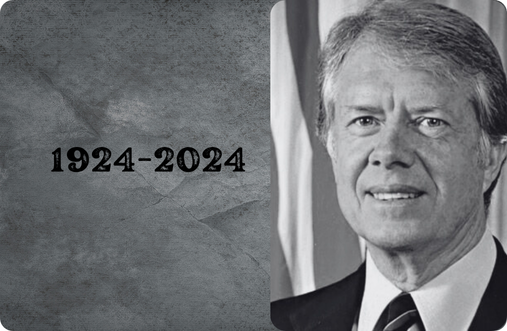
Everything turned into memories as the world mouth shut down in the long sad breath from the farewell to Jimmy Carter, longest-living president in the history of U.S. On October 1, 1924, born in Plains, Georgia, he reached an astounding age of 100 years and left behind a legacy of peace, humanitarianism, and moral leadership. Across a lifetime, Jimmy Carter not just served as president of the United States but also stood as a symbol for how a person might conduct himself with conviction, integrity, and compassion.
From the time he was a childhood rural Georgia farm boy, until he became the 39th president of the United States, all his milestones, personal or professional, were world-changers. The journey of his presidency been eventful with fortunes and misfortunes-all history-changing. It set the very foundation of the moral compass that would guide America’s foreign policy. After leaving the Oval Office, he devoted himself to a lifetime of humanitarian service as a global ambassador for peace and human rights.

Table of Contents
ToggleEarly Life and Rise in Politics
Birth and Upbringing
In 1924, Jimmy Carter took his first breaths in a little town called Plains, located in the state of Georgia. His parents were Earl and Lillian Carter. From the onset, he was brought up as part of a humble agricultural family, which instilled in him faithfulness to duty, religious devotion, and a rather strong sense of justice. Therefore, Carter acquired an early experience of life on family farm, where among other influences, one could feel his father’s strong work ethic and motherly love, or rather, husband’s compassionate care even in difficult times. At this time, Carter imbibed the early lessons in humility, responsibility, and moral clarity that would rule his future decisions.
- Birthplace: Plains, Georgia, on October 1, 1924.
- Family Background: Raised on a peanut farm in the rural South, where he developed a deep respect for hard work and Christian values.
- Education: Graduated from the U.S. Naval Academy in 1946, where he was trained as a submariner.
Early Political Career
Upon the conclusion of military service, he returned to the state of Georgia and entered local politics. His first step in the political arena came in 1962 when he became a member of the Georgia State Senate. Throughout his short time in the Senate, he gained the reputation of being progressive, reformist, and trying to modernize Georgia’s system of government and even create racial integration.
In 1970, he was elected governor of Georgia. As governor, Carter brought in a host of progressive reforms that ranged from the fields of education to health services and environmental protection. He also instituted measures to eliminate the grip of powerful political machines and fought for equal rights amid a volatile period in the South.
The Presidency of Jimmy Carter
Key Accomplishments
1. The Camp David Accords (1978)
But they would not be the last achievement. In fact, chief of all accomplishments, perhaps, was his brokering of historic Camp David accords in 1978 that brought about the first peace treaty between Israel and an Arab nation, Egypt. These accords were the end of intense negotiations launched by Egyptian president Anwar Sadat and Israeli prime minister Menachem Begin. In it all, Carter played a central role, personally shuttling between the leaders and working tirelessly for an agreement.
In addition to ending decades of hostility with Egypt, the Camp David Accords served to set a course for peace in the Middle East. Thus, this earned Jimmy Carter the Nobel Prize for Peace in 2002, completing his legacy as a prophet of peace.
2. Human Rights as Foreign Policy
Early on in his presidential term, Jimmy Carter established human rights as a foundation for U.S. foreign policy. He stated that the country shouldn’t stand by dictatorships or regimes that violated the basic rights of their citizens. Carter stressed democracy, arms reduction, and self-determination of oppressed peoples.
- Policies: Cut aid to countries with poor human rights records, such as Chile and Argentina.
- Promotion of Democracy: Supported democratic movements in countries like Nicaragua and the Philippines.
3. Energy Crisis and Economic Challenges
President Jimmy Carter, when he assumed office, found himself in an economically unstable situation that was compounded by the energy crisis of the 1970s triggered by the oil embargo by OPEC. This led to a sharp increase in both energy prices and a long queue at gas stations. Rising inflation coupled with increasing unemployment led him to take steps that included a variety of policies aimed directly at decreasing inflation and energy conservancy in the nation.
The creation of the Department of Energy as well as the promotion of alternative energy sources were parts of more emphatic energy conservation and efficiency efforts. The complementary activities, however, were met with a lot of resistance, further compounding his political challenges due to the country’s economic woes.
Major Setbacks and Controversies
Despite his achievements, Jimmy Carter’s presidency was not without its challenges and controversies.
1. The Iran Hostage Crisis (1979-1981)
In November of 1979, the Iran Hostage Crisis stunned Carter’s administration. Iranian terrorists stormed the U.S. Embassy in Tehran and took 52 American citizens hostage. The impasse lasted for 444 days, and failure to resolve it during Carter’s presidency is often given as a reason for his defeat in the election of 1980.
- Impact: The crisis overshadowed much of Carter‘s final year in office and led to a decline in his popularity.
2. The 1980 Election Loss
In the election for president, Jimmy Carter went against former California Governor Ronald Reagan in 1980. Though he worked the drama of the energy crisis and the Iranian hostage situation, he lost in a landslide. Reagan took office in January 1981, marking the end of Carter’s presidency. However, this election did not erase the future role he would have in humanitarianism and diplomacy.
Post-Presidency: Lifelong Commitment to Service
Key Initiatives Post-Presidency
Jenna will not return home after leaving the office. In fact, she took it into the ground. He has dedicated years of his life to development work and globalism diplomacy activism. Even after his retirement, such activities would only further fortify his legacy as one of the most influential former presidents in US history.
1. Habitat for Humanity
One of Carter’s most enduring efforts after presidency was really to work in Habitat for Humanity, which is a philanthropic nonprofit organization for building affordable houses for needy families. Carter became a vocal spokesman for the nonprofit house-wide build in the U. S. together with associated volunteers abroad. He has further loved millions out of poverty through affordable housing.
2. The Carter Center
The Carter Center was established in 1982 as a channel through which Carter would conduct his activities after leaving the presidency. Its mission is to improve human rights, relieve suffering, and enhance the health of people worldwide. Major initiatives of the Carter Center include:
- Conflict Mediation: Facilitating peace talks in regions such as Sudan and Haiti.
- Guinea Worm Eradication: Working to eliminate Guinea worm disease in Africa, reducing the number of cases from millions to a few dozen.
- Global Health: Addressing diseases like malaria, HIV/AIDS, and river blindness through health initiatives.
Achievements in Peace and Diplomacy
Jimmy Carter continued his legacy of diplomacy and peace after his presidency. His efforts were focused on conflict resolution, promoting democracy, and improving health standards worldwide. Below is a table summarizing his key diplomatic achievements:
| Achievement | Details |
|---|---|
| Camp David Accords (1978) | Historic peace treaty between Egypt and Israel, brokered by Jimmy Carter. |
| Nobel Peace Prize (2002) | Awarded for his continued efforts in conflict mediation, human rights advocacy, and disease eradication. |
| Conflict Mediation | Actively mediated conflicts in Sudan, Haiti, and Bosnia. |
| Democracy Promotion | Worked on election monitoring in countries like Kenya and Zambia, ensuring free and fair elections. |
Jimmy Carter’s Lasting Legacy
Core Aspects of Jimmy Carter’s Legacy
- Moral Leadership
Jimmy Carter’s presidency was marked by his commitment to morality and ethical leadership. He believed that the U.S. should be a force for good in the world, promoting democracy and human rights. Even in the face of political adversity, he remained steadfast in his principles, prioritizing values over expedience. - Global Peace and Diplomacy
Carter‘s success as a diplomat was not limited to his time in office. His post-presidency efforts in mediating conflicts and advocating for peace demonstrate his dedication to international cooperation and human welfare. - Humanitarian Work
Jimmy Carter’s work with organizations like Habitat for Humanity and the Carter Center focused on alleviating human suffering. Through these initiatives, he became a beacon of hope for millions around the world, especially those in impoverished regions.
The Passing of Jimmy Carter: A Reflection on His Life
Jimmy Carter passed away on December 30, 2024, at the age of 100. Tributes poured in from world leaders, organizations, and individuals, all acknowledging his impact on global peace, human rights, and democracy. His family remembers him as a “hero” who “taught us the importance of caring for others.”
Conclusion: A Legacy That Endures
For selfless service and integrity in leadership, indeed the poignant example is that of Jimmy Carter’s life: His presidency was full of trials and tribulations, but it did transform foreign policy and global diplomacy within the United States. In his years after the presidency, Carter would further firm up his legacy as an advocate for peace, human rights, and humanitarian activities around the globe.
There is, indeed, a legacy that Jimmy Carter will bequeath to posterity through commitment to peace and work tirelessly uplift the lives of others. For posterity, indeed, that legacy will stand such as to remind everyone that real leadership is not power but concern for other people.
And in Jimmy Carter’s own phrase, “Putting our hands and hearts together to serve others makes all the world a better place.” Jimmy Carter lived this principle daily during his life and will continue to inspire people well into the future.
If you are interested in ind vs aus match (nitish kumar reddy century) than click here.
